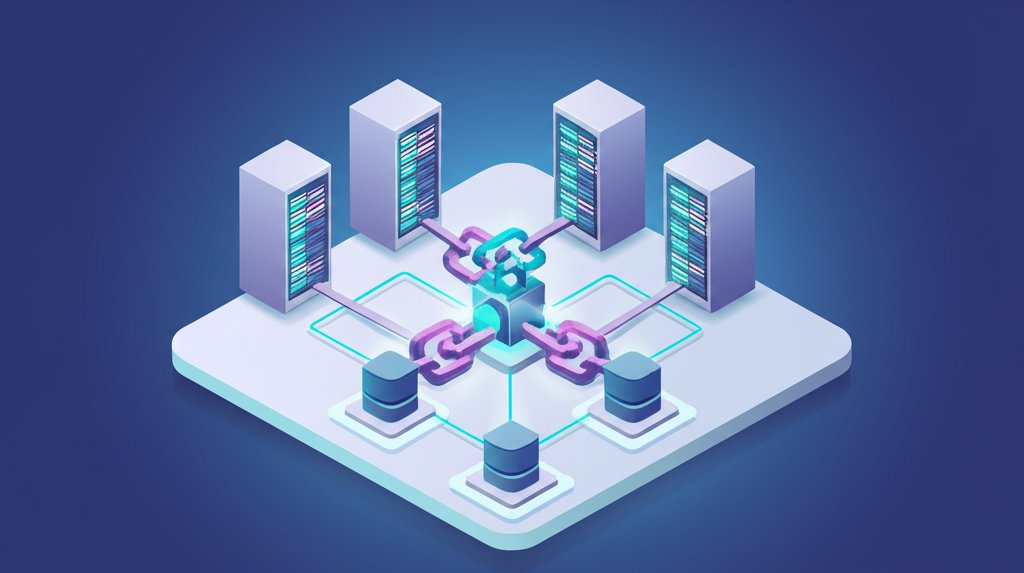
In a world increasingly driven by digital collaboration, organizations face a critical tension: how to share sensitive information and streamline processes with partners while maintaining stringent control over data privacy and access. This challenge is precisely where the power of private blockchain networks shines. Unlike the open, permissionless realms of public blockchains, private networks offer a controlled environment, enabling enterprises to harness distributed ledger technology for efficiency gains without sacrificing confidentiality or clear governance.
You're likely exploring blockchain to solve real business problems—perhaps to ensure supply chain transparency, streamline interbank settlements, or manage sensitive healthcare records. For these use cases, where speed, cost predictability, and granular control over who sees what are paramount, private blockchain solutions often present the most pragmatic path forward.
At a Glance: Private Blockchain Fundamentals
- Controlled Access: Only approved, identifiable participants can join the network, read data, or validate transactions.
- High Performance: Designed for enterprise scale, offering significantly faster transaction speeds and lower, more predictable costs than public alternatives.
- Enhanced Confidentiality: Allows for strict data privacy, ensuring sensitive information is only shared with authorized parties on a need-to-know basis.
- Clear Governance: A single entity or a defined consortium controls the network, enabling easier upgrades, dispute resolution, and regulatory compliance.
- Ideal for Enterprise: Best suited for internal processes, supply chain management, inter-organizational data sharing, and digital asset tracking where privacy and control are non-negotiable.
- Not Fully Decentralized: While distributed, control remains centralized or federated among a few trusted entities, distinguishing it from the broader decentralization ethos of public chains.
The Differentiating Edge: Why Private Blockchain Matters for Business
At its core, any blockchain aims to create a shared, immutable record of truth among multiple parties without relying on a single central authority. Participants maintain a copy of the ledger, and a consensus mechanism ensures all copies match. Once recorded, data becomes exceptionally difficult to alter. But how this shared truth is managed—and by whom—defines its utility for different contexts.
While public blockchains thrive on global, open participation, supporting cryptocurrencies and decentralized finance (DeFi) with unparalleled censorship resistance, they come with trade-offs: slower transaction speeds, higher costs during peak demand, and a lack of privacy where all transactions are publicly visible. If you're building an open ecosystem that requires global access and absolute neutrality, public networks might be your answer. You can learn more about these open networks and their unique advantages here: Explore public blockchain networks.
However, for enterprises, the requirements are often different. Businesses need to integrate sensitive data flows with existing systems, comply with strict regulations, and maintain predictable operational costs. This is where private blockchains step in, offering a tailored environment. They are essentially distributed ledgers operating in a closed ecosystem, managed by one or several entities that dictate access and participation rules.
Performance, Privacy, and Predictability: The Core Advantages
The appeal of private blockchain for enterprise stems from its optimized design for business environments.
Blazing Fast Transaction Speeds
In a private network, the number of validating nodes is significantly smaller and often consists of high-performance servers controlled by trusted organizations. This streamlined setup allows consensus mechanisms to operate much more efficiently than in public networks like Bitcoin or Ethereum. Transactions can be confirmed in seconds, not minutes, translating to thousands of transactions per second (TPS) versus tens or hundreds. This speed is crucial for high-volume enterprise operations, such as real-time supply chain tracking or instant interbank settlements.
Granular Data Confidentiality
Perhaps the most compelling advantage for businesses is the ability to maintain strict data privacy. Unlike public blockchains where all transactions are transparent, private networks enable confidential transactions and restrict data visibility. Participants only see the data relevant to them, often through cryptographic techniques or by segmenting the ledger. This "need-to-know" access is vital for industries dealing with proprietary information, personal health records (PHI), or financial data, where regulatory compliance (like GDPR or HIPAA) is non-negotiable.
Predictable Costs and Scalability
Public blockchain transaction fees can fluctuate wildly based on network congestion, leading to unpredictable operational expenses. Private blockchains, conversely, offer predictable and often lower transaction costs because there are no mining rewards or competitive bidding for transaction inclusion. The underlying infrastructure and its operational costs are typically known. Furthermore, these networks are built to scale within defined parameters, allowing organizations to expand their distributed ledger capabilities as business needs evolve without being beholden to external network dynamics.
Clear Governance and Regulatory Alignment
In a private network, a defined entity or consortium holds governance rights. This means that rules for participation, data management, dispute resolution, and network upgrades are clearly established and can be adjusted as needed. This centralized or federated control simplifies regulatory compliance, as there is a clear chain of responsibility and accountability. Enterprises can easily demonstrate adherence to legal frameworks, which is often difficult in truly permissionless environments.
When Private Makes Perfect Sense: Ideal Use Cases
Private blockchains excel in scenarios where multiple parties need to share a common, tamper-proof record, but trust is either limited or requires explicit management, and confidentiality is paramount.
- Supply Chain Management: Track goods from origin to consumer with unparalleled transparency and immutability, while ensuring sensitive supplier agreements or pricing data remain private. Companies can verify product authenticity, manage inventory, and optimize logistics, reducing fraud and improving efficiency.
- Interbank Settlements: Facilitate fast, secure, and confidential clearing and settlement of financial transactions between banks. This reduces the time and cost associated with traditional correspondent banking, minimizes counterparty risk, and maintains privacy over transaction details.
- Healthcare Records: Create a secure, auditable, and confidential ledger for patient medical records. Only authorized healthcare providers, patients, and insurers can access specific data, ensuring privacy while improving data interoperability and preventing medical fraud.
- Government Registries (Land, Identity): Digitize and secure public records like land titles or citizen identities. This improves efficiency, reduces corruption, and makes records tamper-proof, while allowing government agencies to control access and verify identities.
- Enterprise Resource Planning (ERP) & Inter-company Collaboration: Streamline data exchange between internal departments or with trusted business partners (e.g., procurement, manufacturing, logistics) within a large enterprise or a closed business ecosystem.
Navigating the Nuances: Understanding the Trade-offs
While offering significant advantages, it's crucial to acknowledge the inherent trade-offs of private blockchains, primarily concerning trust and decentralization.
Trusting the Administrators
The core difference between public and private blockchains lies in the locus of trust. In public blockchains, security and integrity arise from mass participation and cryptoeconomic incentives (e.g., Proof-of-Work, Proof-of-Stake), minimizing the need to trust any single entity. In a private blockchain, however, you must trust the administrator(s) who control the network. These entities have the right to approve participants, manage upgrades, and potentially even alter or delete data (though immutability features are often maintained by policy and cryptographic proofs). This reliance on administrators means less censorship resistance compared to public chains.
Centralized Control vs. Distributed Ledger
A private blockchain is a distributed ledger, but it is not fully decentralized in the same way a public blockchain is. Control typically resides with a single organization or a small consortium. This arrangement provides clear governance and decision-making but also means the network's resilience to attack or failure might be less robust than a public chain with thousands of independent nodes. A smaller number of validators can potentially lead to security vulnerabilities if compromised.
The Permissioned Spectrum: Private vs. Consortium
It's helpful to distinguish between a purely "private" blockchain (often controlled by a single entity) and a "permissioned" or "consortium" blockchain (managed by a group of organizations). Both require identity verification and specific roles/permissions, but a consortium model distributes control more broadly among its members, offering a middle ground between single-entity private chains and fully open public chains. Many enterprise blockchain platforms support both private (single-entity) and consortium (multi-entity) deployments.
Designing Your Private Network: Key Decisions for Implementation
Implementing a private blockchain requires thoughtful planning and strategic decisions.
1. Defining Your Use Case and Participants
Before diving into technology, clearly articulate the business problem you're solving.
- What data will be shared? What level of confidentiality is required for each piece of data?
- Who needs to participate? Are they internal departments, trusted partners, or a broader consortium?
- What are the regulatory requirements? How will compliance be maintained?
- What business processes will be transformed? Outline the "before" and "after" states.
2. Selecting a Consensus Mechanism
Private blockchains don't rely on resource-intensive mechanisms like Proof-of-Work. Instead, they opt for more efficient, trust-based alternatives:
- Proof of Authority (PoA): Trusted validators (authorities) sign blocks. This is fast and efficient but relies heavily on the integrity of the chosen authorities. Ideal for networks where trust among validators is high.
- RAFT (Leader-based consensus): A robust consensus algorithm often used in distributed systems. A leader node manages transactions, with followers replicating the ledger. It's fast and tolerates node failures.
- Practical Byzantine Fault Tolerance (PBFT): Designed for asynchronous distributed systems, PBFT can tolerate malicious (Byzantine) nodes up to a certain threshold. It offers strong finality and is highly secure for critical applications but can be less scalable than PoA.
3. Choosing a Platform and Toolset
Several robust platforms cater specifically to private and permissioned blockchain deployments:
- Hyperledger Fabric: An open-source, modular framework from the Linux Foundation. It allows for private channels, pluggable consensus, and smart contracts written in various languages. Excellent for complex supply chains and enterprise integrations.
- R3 Corda: Designed specifically for financial institutions, Corda focuses on privacy and direct, bilateral transactions rather than a globally shared ledger. It's often favored for interbank settlements and trade finance.
- Quorum (fork of Ethereum): An enterprise-focused version of Ethereum, offering transaction privacy and higher performance. It leverages Ethereum's EVM for smart contracts but with a permissioned network model.
- Enterprise Ethereum (e.g., ConsenSys Quorum, Hyperledger Besu): Leverage the popularity and developer tooling of Ethereum while adding enterprise features like permissioning and privacy.
4. Managing Identity and Access
A crucial component is robust identity management. Each participant must be verified and granted specific roles and permissions. This involves:
- Identity Provisioning: Onboarding new participants, verifying their credentials.
- Access Control: Defining who can read, write, or validate specific types of data or transactions (e.g., using Attribute-Based Access Control or Role-Based Access Control).
- Key Management: Securely managing cryptographic keys for participants.
5. Architecting for Privacy
While private networks inherently offer more privacy, specific techniques can further enhance confidentiality:
- Private Channels: (e.g., Hyperledger Fabric) allow subsets of participants to conduct transactions and maintain a separate, private ledger within the broader network.
- Off-chain Data Storage: Only hashes of sensitive data are stored on the blockchain, with the actual data stored in separate, permissioned databases.
- Zero-Knowledge Proofs (ZKPs): Emerging technology that allows one party to prove a statement is true to another party without revealing any specific information beyond the truth of the statement itself. While complex, ZKPs offer powerful future-proofing for privacy.
The Private Blockchain Playbook: From Concept to Production
Moving from a theoretical understanding to a working private blockchain requires a structured approach.
Phase 1: Proof of Concept (PoC) & Pilot
- Identify a critical, contained business process: Choose a specific pain point with clear, measurable outcomes.
- Form a dedicated team: Include business stakeholders, blockchain developers, security experts, and legal counsel.
- Select a platform: Based on your use case, scalability needs, and existing technology stack.
- Build a minimal viable product (MVP): Focus on core functionality. Demonstrate how the blockchain solves the identified problem and calculate potential ROI.
- Test with real data (anonymized): Run simulations and test performance, privacy, and user experience.
Phase 2: Scaling and Integration
- Expand participation: Bring in more internal departments or external partners into the pilot.
- Integrate with existing systems: Connect the blockchain solution with your ERP, CRM, or other legacy systems using APIs or middleware. This is often the most complex part of enterprise blockchain adoption.
- Strengthen governance: Formalize legal agreements, operational rules, and dispute resolution processes for all participants.
- Conduct security audits: Engage third-party experts to rigorously test the network's security, smart contract code, and access controls.
Phase 3: Production and Optimization
- Go live: Deploy the private blockchain solution into a production environment.
- Monitor performance: Continuously track transaction speeds, latency, and resource utilization.
- Iterate and optimize: Gather feedback from users and stakeholders, and continuously refine the solution, adding new features or improving existing ones.
- Plan for upgrades and maintenance: Establish clear procedures for platform updates, security patches, and network changes.
Quick Answers: Common Questions and Misconceptions
"Isn't a private blockchain just a glorified database?"
Not quite. While both store data, a private blockchain fundamentally differs by being a distributed ledger with cryptographic immutability and a consensus mechanism. Unlike a traditional database controlled by a single administrator who can easily alter entries, a private blockchain's records are replicated across multiple nodes and secured by cryptographic hashes, making past entries virtually tamper-proof. Changes require consensus among predefined participants, adding a layer of trust and auditability beyond what a typical database offers.
"Is a private blockchain truly decentralized?"
It is distributed but not fully decentralized in the sense of a public, permissionless network. Private blockchains distribute the ledger across multiple nodes, but control over who participates, who validates, and how the network evolves remains with a central entity or a predefined consortium. This controlled decentralization is a feature, not a bug, designed to meet enterprise needs for governance and compliance.
"Can private blockchains connect to public ones?"
Yes, the trend is towards greater interoperability. Hybrid models are emerging where private networks can interact with public ones. For instance, a private blockchain might record high-volume, sensitive transactions internally, and then periodically "anchor" a cryptographic proof of these transactions onto a public blockchain (like Ethereum) to gain an additional layer of immutability and public verifiability, without exposing the underlying confidential data. This allows businesses to leverage the strengths of both environments.
"Are private blockchains more secure than public ones?"
The nature of security differs. Public blockchains derive security from their vast number of independent participants and high cost of attack. Private blockchains rely on the integrity of their fewer, known validators and robust access control mechanisms. A private network's security is only as strong as its weakest link among its trusted participants. It benefits from a smaller attack surface, but also from fewer eyes on the code and operations. Both have different attack vectors.
Your Next Step: Weighing Control Against Openness
Deciding on a private blockchain isn't just a technological choice; it's a strategic business decision. It represents a trade-off where you gain speed, confidentiality, and predictable costs, but accept a different form of trust and governance than a public, open network provides.
For organizations needing to share sensitive data securely, streamline processes with known partners, and maintain tight control over their digital environment, private blockchains offer a mature, effective solution. Start by identifying a specific, high-value problem within your organization or consortium, build a small-scale pilot, and then strategically scale your solution. The journey to enterprise efficiency through private blockchain is often iterative, but the gains in trust, transparency, and operational velocity can be transformative.